
How to Search the Buffalo Court Docket
The town publishes no search form, municipal calendar, or judge roster online. There is no official traffic payment portal either. So begin with the notice itself. Write down the court name and the issuing agency. Add the citation or case number, the event date, and whatever action it requests. Then call Town Hall and ask which local office actually keeps that record.
- Read the full court name on the Buffalo notice.
- Call Town Hall at 304-937-2041 for a town matter.
- Ask which office or court holds the cited file.
- Request the current date, docket, disposition, or copy process.
- Use MCR or WVPASS only when a state court is named.
A state database result never replaces the actual Buffalo town file. Check that the court, case number, and case type all match before you rely on any entry you find.
Buffalo Town Hall Starts the Search
The official Town of Buffalo site gives the street address as 153 Franklin Street, Buffalo, WV 25033. Mail goes to PO Box 307 instead. The public telephone is 304-937-2041, and the fax is 304-937-3957.
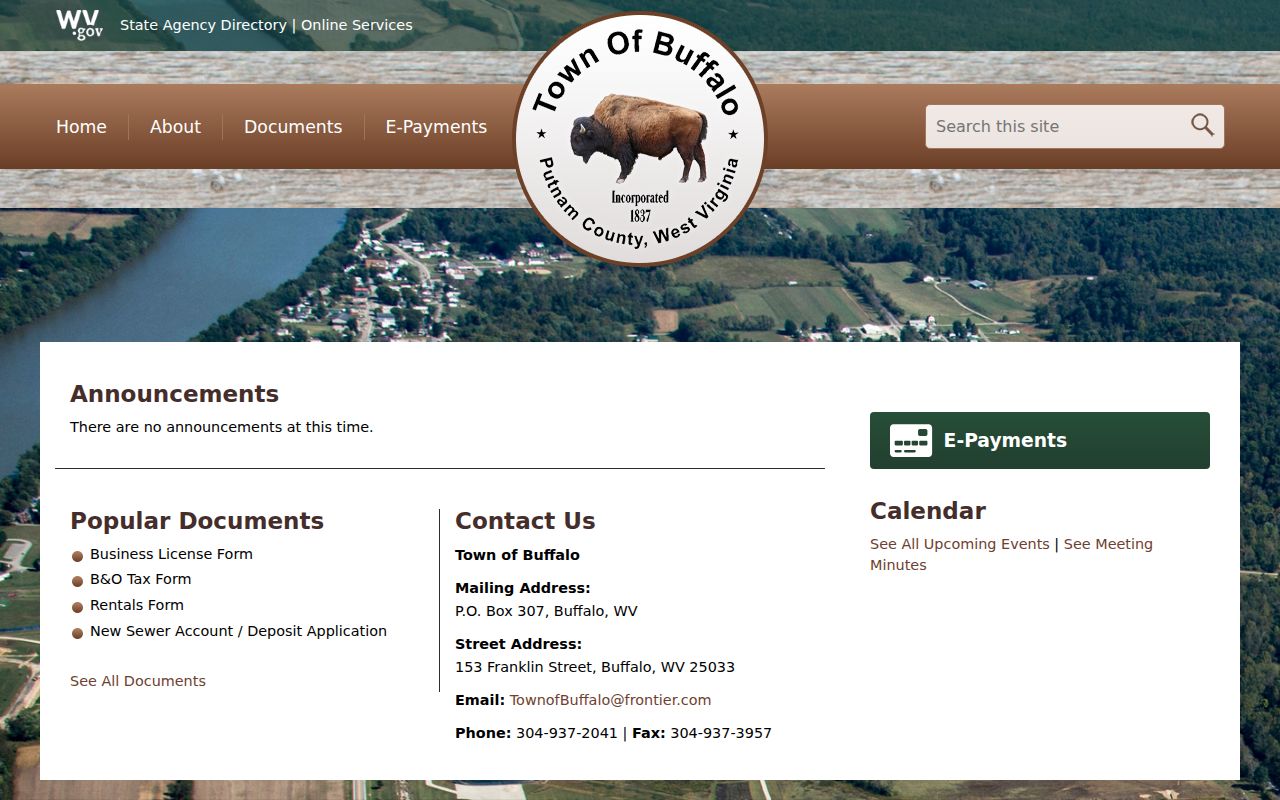
That official page is a contact source, not a live docket. Ask Town Hall whether a municipal clerk, a court function, a police office, or some other custodian holds the exact citation or ordinance record you need. Before mailing anything, confirm the right submission address, because the street address and the PO Box serve different purposes.
The Buffalo Municipal Court
The town site does not confirm a municipal-court page, a judge, a schedule, payment methods, or a copy-fee list right now. Treat that as an open question. It is not evidence that no municipal court exists. Town Hall has to confirm the current local structure for your particular notice.
Evidence boundary: No Buffalo portal exists online. Contact the town to verify the custodian and how the court currently operates, rather than filling the gap with statewide assumptions.
If your notice names a city court or an ordinance matter, ask for the municipal case number, the current session date, payment options, and the records process. Never rely on an unverified judge name or deadline.
Buffalo Court Search Has Three Routes
One Buffalo address can lead to three different record paths. A town ordinance matter starts locally. A state misdemeanor, a preliminary felony matter, or a limited civil case may belong to Putnam Magistrate Court, while general-jurisdiction, appeal, and family matters go to the corresponding state court level.
| Notice names | First route | Record limit |
|---|---|---|
| Buffalo town or city matter | Town Hall custodian check | No public local index found |
| Putnam Magistrate Court | MCR Search | Detail online, documents from clerk |
| Putnam Circuit or Family Court | WVPASS | Public records subject to access limits |
Never route a case by population or street address. The court named on the paper controls. If Town Hall redirects your request, keep the exact case identifier handy and repeat it to the state clerk.
Buffalo Court Dates and Settings
Buffalo posts no current public court calendar. Confirm any date with Town Hall or with the court named on your notice. Have the citation number, issuing agency, date, and appearance details ready when you call, and ask whether a continuation or reset was actually approved.
| Date | The date on the latest Buffalo notice or current clerk record. |
|---|---|
| Time | The case-specific time confirmed by the custodian. |
| Location | The place printed on the notice or stated by the court. |
| Case key | The municipal citation or state case number. |
| Setting type | Appearance, hearing, trial, compliance, or another event. |
A requested change is not a granted reset. Keep the latest written notice, get direct confirmation, and never infer today's schedule from a general town document page.
Buffalo Population Does Not Pick Court
Buffalo had 1,211 residents in the cited 2020 Census TIGER incorporated-place table, ranking fifth among Putnam County's incorporated places. That number describes the community's scale at one point in time. It says nothing about docket volume. It plays no role in choosing jurisdiction.
A single Buffalo event can produce a town ordinance file, a state magistrate case, or a higher state case. Route by the charge level, subject matter, court heading, and case identifier. The town's size stays out of it.
Buffalo Traffic Tickets
Buffalo offers no official traffic payment page or municipal citation lookup online. Call 304-937-2041 and ask which court holds the ticket. Ask as well whether an appearance is required, which payment routes are current, and what deadline controls. A missing town portal is no reason to send payment to an unrelated state system. If the ticket names Putnam Magistrate Court and carries an exact state citation or case ID, the West Virginia payment system may apply. Its exact-match fields require the full identifier, dashes included. That is not a name-based Buffalo docket search. The Putnam County traffic court records page explains the wider traffic routing.
Buffalo Clerk Questions Before Visiting
A short call can save you a trip to the wrong office. Tell Town Hall which court the notice names and ask who maintains that type of record. Then confirm the address, office hours, copy method, cost, and current date.
- Court and issuing agency on the notice
- Citation or case number
- Approximate filing or ticket date
- Appearance date printed on the paper
- Docket, disposition, or document needed
- Plain or certified copy preference
No certified-copy fee for Buffalo appears online. Ask the verified custodian for the amount rather than applying a Putnam County fee to a town record. For mail, confirm whether PO Box 307 is the correct destination and what identifying detail to include.
Where Buffalo Cases End Up
A Buffalo town matter may stay local. Putnam Magistrate Court receives qualifying state lower-court cases. Circuit Court handles general-jurisdiction matters plus qualifying appeals. Family matters follow the Family Court and Circuit Clerk route. A municipal appeal creates a new circuit-level record. It does not extend any online Buffalo town page.
Docket flow: Buffalo municipal matter › Putnam County Courts › West Virginia Circuit Court, Seventh Judicial Circuit
Hang on to the local case number, the outcome, and the date before you raise an appeal question with the Putnam Circuit Clerk. The county fee page shows $200 for an appeal to circuit court. That figure settles nothing about eligibility or timing, though. Ask the right clerks for current filing instructions and required papers before you submit anything.
Buffalo Ticket Names Magistrate Court
If the notice names Putnam Magistrate Court outright, the free MCR Search is the tool. It will take it from there. Get past the captcha and terms screen first. Then search by first name, last name, or case number. A result can include case detail, charges, the event schedule, and docket rows. Document images are not supplied online, though. Copies come from Magistrate Court Clerk Darry Casto at 304-586-0234 or 304-586-0270. An exact payment identifier may open the state payment system. Copy every digit and dash exactly. Skip both tools for a Buffalo town case unless the notice confirms the state court route.
Public Access to Buffalo Court Records
A public request for Buffalo town records works best when it names the case or citation, the date, the issuing office, the specific docket or document, and the copy type. West Virginia law generally backs inspection and copying. Court rules, confidentiality statutes, exemptions, sealing, and redaction can still narrow what gets released.
Key rules:
W.Va. Code § 51-4-2 addresses inspection and copies of court papers unless another limit applies.
W.Va. Code § 29B-1-3 covers specific requests, response time, electronic records, and actual reproduction cost.
W.Va. Code § 29B-1-4 lists exemptions that can restrict access.
The town itself can tell you who keeps the local record. A state case belongs with the corresponding clerk. A protected record stays protected even when a public search returns nothing.
Buffalo Court Record Types
Name the record you want when you contact Buffalo. Each type answers a different question. A narrow request beats a vague ask for some undefined file.
- Docket
- The dated sequence of court events and filings.
- Calendar
- The future setting and its time or location.
- Disposition
- The court’s recorded outcome or status.
- Payment receipt
- Evidence of a transaction, not a complete case history.
- Certified copy
- A record authenticated by the proper clerk.
Ask the office whether the record exists, what portion is public, and what the current cost runs. A missing web page answers none of that.
Buffalo Court Search Final Check
Check any result against the court name, the jurisdiction, the citation or case number, the filing date, and the event date before you rely on it. The match should be complete. A Buffalo street or mailing address alone will not identify a case.
| Check | Why it matters |
|---|---|
| Court name | Separates town custody from state custody |
| Exact identifier | Avoids mixing similar matters |
| Latest event | Shows whether the date or status changed |
| Copy type | Distinguishes plain information from certification |
Verify the final Buffalo setting or outcome with the court or clerk that handled the matter. Go straight to the source. That direct check matters most where the official town site lists contacts but offers no searchable municipal docket.
Buffalo Docket Inspection and Copies
Keep inspection and copying separate in a town request. Ask whether the Buffalo record can be viewed during usual hours, whether an electronic copy exists, and whether certification is offered. Case-specific answers and current fees come from the office that holds the record, since no court fee schedule is published online for these questions.
When Town Hall points to a magistrate case, MCR can show the public case location, filing date, appearance date, charge, event schedule, and docket rows. The underlying documents stay out of reach there. The Magistrate Clerk handles copies and clarification. Use the exact case number, because a name search may pull up several records.
For a circuit or family matter, WVPASS is the public search layer. Some public electronic documents may be available. Sealed files, juvenile records, and other protected material are excluded. Family orders and indices can be public even where pleadings and exhibits stay confidential, and the Putnam Circuit Clerk can explain lawful access and certification.